
Writer: Brian Guo
Mitosis and meiosis are two important types of cell division that occur in living organisms. Each type of division is essential for life. For instance, without the division of cells, organisms would not be able to grow, repair their bodies, or create new organisms. Although each type of division is similar to the other in some ways, there are important differences between the processes. Furthermore, understanding the processes of both mitosis and meiosis allows humans to understand processes like growth, wound healing, and the transfer of genetic information from one generation of organisms to the next.
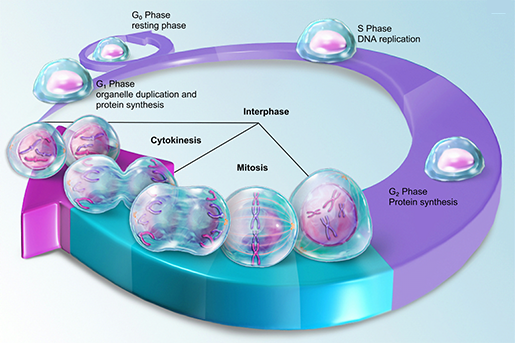
Mitosis is the process of cell division in which two identical daughter cells are produced from a parent cell. Mitosis occurs in the somatic (body) cells of an organism. The purpose of mitosis is to permit an organism to grow, repair its cells, and replace damaged cells. For instance, when an individual is suffering from a cut or wound in the skin, the skin cells divide through the process of mitosis in order to repair the wound. Additionally, an embryo contains single cells that divide through mitosis in order to develop into the much more complex organism that it does.
Prior to the division of a cell through mitosis, that cell must first experience interphase. During interphase, the cell performs the functions that are necessary for the cell to function, grows in size, and replicates its DNA. Thus, each daughter cell will have the same genetic information as the original cell. After interphase, the cell undergoes four main stages of division: prophase, metaphase, anaphase, and telophase.
During prophase, the chromosomes of the cell become visible. The chromosomes begin to condense, the nucleus breaks down, and structures inside the cell, known as the spindle fibers, begin to form. The spindle fibers will assist in the separation of the chromosomes of the dividing cell.
During metaphase, the chromosomes line up in the center of the parent cell. The spindle fibers that project from opposite portions of the parent cell attach to the chromosomes. This even helps to ensure that the daughter cells each receive one copy of each chromosome.
During anaphase, the sister chromatids of each chromosome begin to separate from one another. Additionally, the spindle fibers pull the chromosomes to the opposite ends of the parent cell. The chromatids are now considered to be individual chromosomes.
During telophase, the chromosomes arrive at the ends of the parent cell. The chromosomes begin to uncoil into chromatin (the chemical components of the chromosomes), and new nuclear membranes form around the chromosomes of each dividing cell. Additionally, during telophase, the cytoplasm of the parent cell divides (through a process known as cytokinesis). Cytokinesis results in the creation of two daughter cells. In animal cells, the membranes of the parent cell begin to pinch in the middle of the cell. In plant cells, a cell plate forms in the middle of the parent cell, leading to the formation of new walls that separate the two new cells.
At the end of mitosis and cytokinesis, two cells have been created that are genetically identical to one another and to the original parent cell. Each of these two cells contains the same number of chromosomes as the parent cell. Humans, for instance, contain 46 chromosomes in each of their cells. Thus, the two cells created as a result of mitosis will each have 46 chromosomes as well.
While mitosis is responsible for creating new somatic cells, meiosis is responsible for reproduction. Meiosis is the process that creates the gametes of an organism, the cells that are responsible for the reproduction of an organism’s offspring. In humans, there are two types of gametes: sperm cells and egg cells. Meiosis, however, reduces the number of chromosomes within the cells that are created. Human gametes contain 23 chromosomes, half the number of the somatic cells of the body.
Meiosis is a more complex process than mitosis. Meiosis divides a parent cell into four daughter cells, while mitosis yields two. Each of the daughter cells created through meiosis contain half the number of chromosomes of the parent cell. Additionally, each of the cells created as a result of meiosis contain different genetic information than each of the others. Thus, meiosis is responsible for creating diversity within the species of an organism.
Prior to the initiation of meiosis, the same process as mitosis occurs: interphase. During this phase, the cell replicates its DNA. After interphase, however, there are unique processes that occur within the cell to create genetic diversity within those daughter cells.
The first division that occurs during meiosis is known as meiosis I. Meiosis I is referred to as the reduction division of the cell because it divides the number of chromosomes of the parent cell by half. The stages of meiosis I are prophase I, metaphase I, anaphase I, and telophase I.
Prophase I is the first stage of meiosis I. During this stage, the chromosomes of the parent cell begin to condense and become visible. Additionally, the nuclei of the parent cell break down. Structures within the parent cell, known as the spindle fibers, begin to form. Additionally, during prophase I, the homologous chromosomes (chromosomes that contain the same genes) begin to pair with one another. These homologous chromosomes also exchange genetic material with one another through a process known as crossing over.
Crossing over is a critical process that occurs during meiosis. The exchange of genetic material between the homologous chromosomes results in the creation of diversity within the daughter cells. Each daughter cell will have genetic material from both of the homologous chromosomes that paired during prophase I. Thus, the process of crossing over creates genetic diversity.
Following prophase I is metaphase I. During metaphase I, the paired homologous chromosomes begin to line up in the center of the parent cell. Additionally, the spindle fibers that extend from the opposite portions of the parent cell attach to each of the chromosomes. The alignment of each homologous chromosome to the center of the parent cell ensures that each daughter cell will contain each of the chromosomes of the parent cell.
Anaphase I occurs after metaphase I. During anaphase I, the homologous chromosomes are separated by the spindle fibers. Thus, each of the two resulting cells will contain half the number of chromosomes as the parent cell. Additionally, during anaphase I, the sister chromatids of each chromosome remain attached to one another.
Following anaphase I is telophase I. During telophase I, the chromosomes arrive at the end of each parent cell. The chromosomes begin to uncoil from each other, the new nuclei begin to form in each of the resulting cells, and the cells divide through cytokinesis. Through the completion of telophase I and cytokinesis, two cells have been created that each contain half the number of chromosomes as the parent cell.
Following telophase I is meiosis II. Meiosis II is similar to mitosis. During meiosis II, the chromosomes begin to condense again (prophase II), line up in the center of each of the resulting cells (metaphase II), the sister chromatids separate from one another and move to the end of each of the cells (anaphase II), and the chromosomes begin to uncoil, new nuclei form in each of the cells, and the cytoplasm divides through cytokinesis (telophase II and cytokinesis).
After the completion of meiosis II, four daughter cells are created. Each of the daughter cells created through meiosis II are genetically different from each other. Additionally, each of the daughter cells have half the number of chromosomes as the parent cell. In males, meiosis results in the creation of four sperm cells. In females, meiosis results in the creation of one egg cell and three smaller cells, known as polar bodies.
There are several differences between mitosis and meiosis. For instance, one of the major differences between the two processes is the number of daughter cells created. Mitosis creates two daughter cells, while meiosis creates four. Additionally, the number of chromosomes in each of the daughter cells is different between the two processes. Mitosis results in daughter cells that have the same number of chromosomes as the parent cell, while meiosis results in cells that have half the number of chromosomes. Finally, the genetic information within each type of daughter cell is different. Mitosis creates cells that are genetically identical to one another and to the parent cell. Meiosis, however, creates cells that are genetically different from each other.
Each of the two processes also have different purposes. Mitosis is responsible for the growth of an organism, the repair of those cells, and the reproduction of those organisms without the need for sexual reproduction. In contrast, meiosis is responsible for the sexual reproduction of the organism and the creation of diversity within each species.
Errors can occur during each type of division. For instance, if the cell division that occurs during mitosis is not regulated, the cells of the organism can develop cancer. Cancer is the result of cells continuing to divide without regulation. In contrast, errors during meiosis can result in genetic disorders. For instance, if errors occur in the separation of chromosomes during meiosis, disorders like Down syndrome can be the result of those errors.
Overall, both mitosis and meiosis are vital processes for the survival of an organism and its species. Mitosis is responsible for permitting an organism’s bodies to grow, repair themselves, and reproduce asexually. Meiosis, however, allows for sexual reproduction of the organism and the continuation of the genetic diversity within the species. Thus, although the two processes are similar in some ways, their differences allow organisms to perform different functions and exhibit genetic diversity. Overall, then, each of these processes is essential for the survival of the body and the species of that organism.
“Mitosis and Meiosis – Stem Fellowship.” Stem Fellowship – We Create Equitable Learning Opportunities, Connections, and Experiences for Students to Develop Modern STEM Skills for the Digital Age., 19 June 2022, live.stemfellowship.org/mitosis-and-meiosis/.
Your Genome. “Mitosis versus Meiosis.” Www.yourgenome.org, 2017, www.yourgenome.org/theme/mitosis-versus-meiosis/.
Snider, L. (2022, July 11). Mitosis and meiosis: What’s the difference? Visible Body. https://www.visiblebody.com/blog/mitosis-and-meiosis-whats-the-difference
发表回复