
Writer: Ella Mu
Teaching the Body to Remember: How Vaccines Train Our Immune System
Introduction
When we get a vaccine, we are giving our immune system a rehearsal script for a fight it hasn’t yet had. By the time a real pathogen shows up, the body has already learned what the enemy looks like and how to take it down quickly. That’s how immunization works, and it relies on the most amazing property of the immune system: memory.
The first line of defense is the innate immune system, which is fast but not specific. It cannot distinguish between a flu virus and a cold virus. It can only identify “foreign” and attack. Vaccines target the slower to activate but much more specific adaptive immune system .
The Immune System’s Two Lines of Defense
The first response is from the innate immune system, which is rapid but non-specific. It cannot distinguish between a flu virus and a cold virus. It can only identify “foreign” and attack. The adaptive immune system comes in a little later but is much more precise and that’s what vaccines aim to stimulate. When a pathogen is encountered, antigens (surface molecules that the immune system uses to identify pathogens) are recognized. B-lymphocytes and T-lymphocytes that recognize that specific antigen are activated.
They proliferate and differentiate into plasma cells which mass-produce antibodies shaped to bind that very antigen, marking pathogens for destruction or blocking them from entering cells. Helper T-cells orchestrate the response and cytotoxic T-cells directly kill already infected cells.
Why the Second Exposure Is Faster
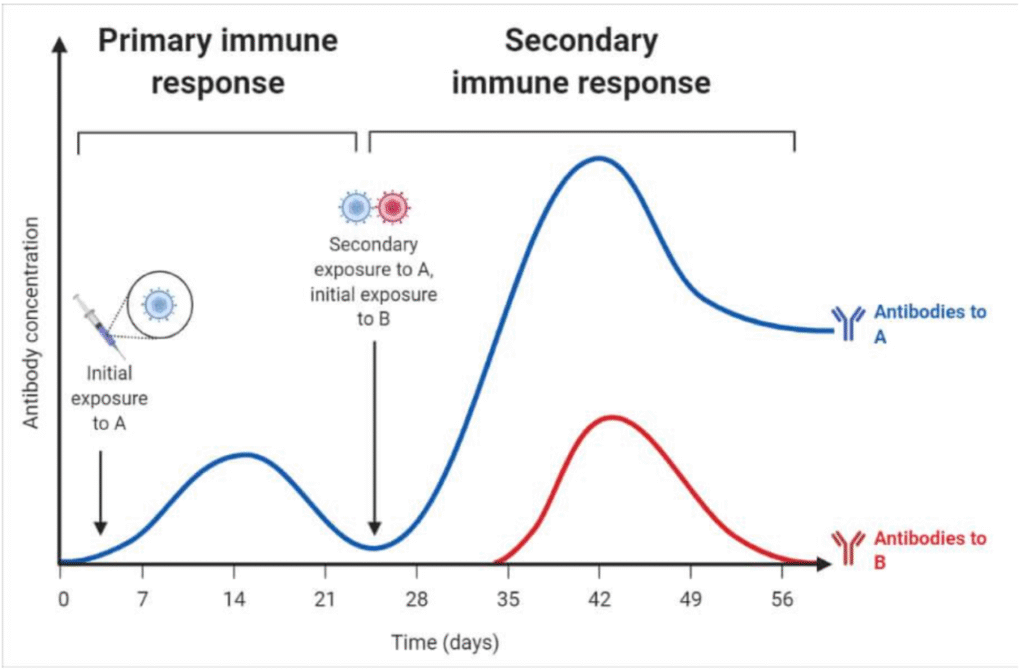
Immunization The key is what happens when the threat has been cleared. Some of these activated B- and T-cells don’t die off. They become long-lived memory cells that circulate for years, sometimes decades. If the same antigen comes back, these memory cells recognize it almost immediately and mount a much faster, larger antibody response, often clearing the pathogen before symptoms even develop. This secondary response is the whole thing principal vaccines take advantage of. They create memory cells without the person having to go through the actual illness first.
Different Vaccine Technologies, Same Goal
Vaccines are mainly differentiated by how they present the antigen to the immune system.
Live-attenuated vaccines are made from a weakened version of the actual virus (e.g. MMR). It’s still a whole replicating organism, so it causes a strong and long lasting response, but generally it is not suitable for people who are immunocompromised.
Inactivated vaccines use the killed version of the germ (for example, some polio vaccines). These are safer for vulnerable groups but the response is weaker and they usually need booster doses
Subunit or protein vaccines use part of the pathogen eg a surface protein (Hepatitis B) and have less side-effect risk as there is no whole virus involved
mRNA vaccines, made prominent by COVID-19 vaccines, take a different approach entirely: they deliver genetic instructions that tell our own cells to temporarily produce a viral protein (like the spike protein), which the immune system then learns to recognize. No live or inactivated virus is introduced at all, and production can be scaled up much faster than traditional methods.
Conclusion
Vaccines do not give the body a shortcut around the immune system; they work with it, using the same B-cell and T-cell machinery the body would use naturally, just without the risk of the actual disease. Understanding this mechanism helps explain not only why vaccines work on an individual level, but why widespread vaccination matters for protecting entire communities.
– Concepts/keywords:
immunology — antigens, B-cells, T-cells, memory cells, vaccine technology, herd immunity
– Picture/visual:
– References/sources
https://immunologyexplained.aai.org/topics/vaccines/how-vaccines-work/\
https://www.cdc.gov/pinkbook/hcp/table-of-contents/chapter-1-principles-of-vaccination.html
发表回复